This blog is for nonprofit, educational purposes - media is incorporated for educational purposes as outlined in § 107 of the U.S. Copyright Act.

Thursday, June 8, 2017

Flat Earth Lies: Flights from Johannesburg to Perth all go far North - BUSTED

Flat Earth Claim


Flights from Johannesburg to Perth all go far North

Here is his little 'infographic':


Globe Earth Reality


Yes, SOME flights go elsewhere FIRST and then fly to other places.  Those are called FLIGHT HUBS.  Not everyone flying to Dubai, Hong Kong, or Malaysia is going to Perth.  In fact, I bet almost NONE of them are going that way.  You COULD go that way if you were desperate and the other flights were full.  Or maybe you want a specific airline.

But OTHER flights, like SAA280 go non-stop from Johannesburg to Perth.


And you're wrong, it's not 11 hours, it's 9 hours.


You clearly didn't research this so I'm calling you a liar.

Haha NO CURVE! Wait, I mean it LOOKS LIKE a curve cuz perspective.

WHICH IS IT?


Well, first of all, Flat Earthers don't understand perspective, which I've covered at some length:


Secondly, it's always funny to see how Flat Earthers shift from

"Haha NO CURVE!"

to

"No, it only LOOKS curved cuz perspective"

or sometimes...

"FAKE MATH" (the same 'math' they are using to try to prove there is no curve)


I've covered numerous long distance views and this is always what they do -- but then they fail to follow-up and acknowledge that they are wrong about perspective.  Perspective simply cannot hide half of a mountain behind the ground, which is below your line of sight.  Perspective doesn't curve anything like that.


Atlanta Skyline from 74 miles away should be IMPOSSIBLE on a Globe! (oh really?)

Canigou from 160 miles - a study in 'Perspective'

Fort Myers to Naples - Flat Earth failures continue

Flat Earth Follies: Mount Denali from Hilltop Ski Area

Flat Earth Follies: Reunion Island from Mauritius - 149 MILES!

Flat Earth Follies: Another Mountain, Another Flat Earth Failure

Flat Earth Follies: Mount Diablo from Loomis CA

Flat Earth Honesty: A Mountain Of Evidence

Flat Earth Follies: The Incredible Shrinking Mountain


How many of these do we have to cover before Flat Earthers learn they must:

#1 take into account the observer elevation

#2 not LIE about the distances

#3 take into account refraction, especially on 100+ mile views

Those three things account for almost 100% of their error.


Wednesday, June 7, 2017

Nibiru APPEARS!

Nibiru appears!  Indisputable evidence!

Original Image Copyright: Barry & Noemi Diacon

Wow, that is really amazing.

We would be STUPID to suspect that something else might be going on, right?

Even APOD: A Triple Sunrise Over Gdansk Bay said "a sincere photographer claims the effect was visible to the unaided eye".

Ok then, that settles it, Nibiru is real.

Oh wait... what was that?

You photographed it through double paned glass?  Hmmm

You have SECOND image?   ఠ_ఠ

APOD: IMG_9810.JPG

And the images shifted as the camera moved?  𝄇⥀.⥀𝄆


Aww...

I guess nobody on the Conspiracy-nonsense side DID THEIR RESEARCH.

Shocking, I know.

Conclusion from the APOD discussion:
This thread is now locked. The cause of the triple sunrise was determined to be a double paned glass window (double glazed). 


Conclusion: BUSTED

Solar Eclipse Calculation Basics: Umbral Size

Certain Flat Earthers have complained that the Sun/Earth/Moon shadow diagrams aren't to scale properly and since I don't want to post a 10 GB image large enough to show anything useful to scale, I'm going to calculate it.

I'm going to calculate the Umbral size for a SOLAR eclipse.  This is where the Moon is a New Moon and it falls in between the Earth and the Sun and the SHADOW OF THE MOON falls on the Earth.  Not EVERY New Moon does this because the Moon's orbit is slightly tilted and an eclipse only happens with the Moon is at (or very near) the Node where the lunar orbit and ecliptic cross.

First the BASIC data we're going to focus on, using the average solar and lunar sizes and distances:

Earth - radius: 6378 km

Sun - radius / diameter: 695,700 km / 1,391,400 km
Sun - distance: 149,600,000 km (varies with time of year)

Moon - radius / diameter: 1737.5 km / 3,474 km
Moon - distance: 384,400 km (varies with time of month)
Moon - surface distance: 384,400 km - (Earth|radius) = 378,022 km

So I just fired up Celestia and used the Navigator option to find the next eclipse and then I moved *MY VIEW* so I could see the Moon and the eclipse shadow on the Earth.  Moving *MY VIEW* doesn't change the relationship between the Sun/Moon/Earth so the shadow doesn't move when *MY VIEW* moves.  Easy as π


If I move my view down to the middle of the dark spot and we look back towards the Moon/Sun, we see the eclipse:


Ok -- so from here the Moon and Sun are lined up.  Now imagine we're looking DEAD CENTER of the moon and just consider the top half of that picture...

We can find the SLOPE of a line from here to Moon very easily.

SLOPE is Rise/Run -- remember that from elementary school?

Rise = Moon Radius (1,737.5 km)
Run = Distance To Moon (378,022 km)

SLOPE = 1737.5/378022

That's the Slope of that line, we can convert a slope to an angle using arctan(SLOPE).

arctan(1737.5/378022) in arc minutes ~ 15.8'

Now that's just half of the moon -- double that to get the full angular size of the moon or about 31' arc minutes.  This matches to reality, although the EXACT angular size of the moon varies by about 14% as it orbits the Earth because it's distance is changing through the month.

Image Credit

This is, BTW, also the "Law of Perspective".

Now do the same thing for the Sun:

Sun - radius / diameter: 695,700 km / 1,391,400 km
Sun - distance 149,600,000 km

arctan(695700/149600000) in arc minutes ~ 15.99'

So we can see the Moon and Sun should appear almost the same size with the Sun just a hair larger using these values.

But at this distance the rays from the TOP part of the Sun and the BOTTOM part of the Sun are going to have a SLIGHT angle.  The Sun's rays are almost parallel ONLY because of the great distances involved but there is still a SLIGHT angle.

TINY IMAGE, Click to Enlarge

So now let's go the other direction and take the angle from the the top of the Sun to the top of the Moon and we can see how far out into space that angle would cross with the one coming from the bottom.

This time our Rise is shorter by the lunar radius and our Run is shorter by the lunar distance.

arctan((695700-1737.5)/(149600000-378022)) in degrees ~ 0.2665°

To extend this angle towards the Earth we need to find the length of the adjacent side since the opposite side here is 1 Moon radius:


We know the trigonometric relationship is:

tan(A) = opposite / adjacent

And we already determined our angle is

A = arctan((695700-1737.5)/(149600000-378022)) 

But the tan(arctan()) term cancels out, leaving us with a very simple math problem:

((695700-1737.5)/(149600000-378022)) = 1737.5 / adjacent

Or approximately 373613 km

Of course, the exact distances from Earth-to-Moon and Earth-to-Sun vary so the size and length of this shadow vary accordingly.

If the distance of the Umbra is shorter than the distance to the Earth, as we calculated here, then we actually see the Antumbra and you see the Ring Of Fire, or annulus, of the Sun and this would be called an Annular Eclipse.

If the moon is a bit closer than the above 'average' value we used then it has a larger angular size and we get a 'normal' Umbral eclipse.  The lunar distance varies from around 357,208 km to 406,603 km -- and the exact distance at Perigee and Apogee vary because of the influence of the Sun (and a few smaller influences).

So, not only does this exactly match what we observe it explains why AND PREDICTS WHEN you can expect to see each type of eclipse.

To calculate the SIZE of the Umbral/Antumbral shadow we would simply take the half-angle and project it out the difference in the distance between the the length of the shadow and the distance to the Earth -- and then double that (because we have a half-angle)...

I'll do it step-by-step first, following the same model as above, but this time we will take the lunar distance as 360,000 km which is 353,622 km from the Earth's surface.

Our first equation to find the Umbral length is:

((695700-1737.5)/(149600000-353622)) = 1737.5 / adjacent

So we get an Umbral length of approximately 373674 km which is greater than the distance to the Earth, 353,622 km this time.

Now we need to take the Umbral length and find where it intersects the Earth's surface, so that's our Umbral length minus the distance to the Moon from the Earth's surface (353,622 km in this case).


And 373674-353622 gives us our intersection at 20052 km - so we take our angle out with the same formula as before:
tan(A) = opposite / adjacent

Except now our adjacent is 20052 and we solve for opposite:

((695700-1737.5)/(149600000-353622)) = opposite / 20052 ~ 90.2373 km

And we double that to get the total width of our Umbra: ~ 127 km

[NOTE: because the Earth surface is actually curved and bumpy the actual width varies slightly from this idealized approximation, but only very slightly. To solve it fully you need to find the surface of intersection between the shadow cone and the exact bumpy shape of the Earth (or at least the Ellipsoid approximation]

We can also simplify this down to the following (just make SURE all your units are the same, you get out whatever you put in -- miles, km, whatever).

m = moon radius
M = moon distance (from Earth's surface)
s = sun radius
S = sun distance

Umbral Diameter ~ 2(M s - m S)/(M - S) where m=1737.5,M=353622,s=695700,S=149600000 ~ 186.473 km

where m=1737.5,M=360000,s=695700,S=149600000,E=6378
where m=1738,M=(356400-6378),s=696000,S=152100000

Can you find the distance from the Earth to the Moon is required to exactly match the Sun's size (for a given solar distance)?

HINT: You want their slopes to match.

Select the below text to see the answer.

1737.5/X = 695700/149600000 ~ 373624 km

How big is the Umbra at that point?


The Earth to Sun distance also changes with the years, Astropixels has a nice chart.

If you want to go out and take accurate measurements you need to find the CURRENT distance to the Moon and to the Sun at YOUR actual location.

Can you calculate the Penumbra now?  How would you go about that?

It's a little more complex but the principles are the same.  Left as an exercise to the reader.


Math Summary


m = moon radius
M = moon distance (from Earth's surface)
s = sun radius
S = sun distance (from Earth's surface)

θ = arctan((s-m)/(S-M)) -- the angle of the shadow
adjacent = opposite / tan(θ) -- trigonometric identity, to find shadow length
tan(arctan()) cancels out, and opposite is moon radius
adjacent = m / ((s-m)/(S-M))

approx Umbral Diameter ~ 2 * (adjacent - M) * tan(θ)
substitute
approx Umbral Diameter ~ 2 * ((m / ((s-m)/(S-M))) - M) * ((s-m)/(S-M))
simplify
approx Umbral Diameter ~ 2 * (m S - M s) / (S - M)

TECHNICAL NOTE: the "moon radius" here should actually be the lunar horizon radius because the light is tangent off the sphere of the Moon.  For this you can use θ = arcsin((s-m)/(S-M)).  However, at these distances it makes little difference and gives us a simple algebraic way to approximate the size of the umbra.

Tuesday, June 6, 2017

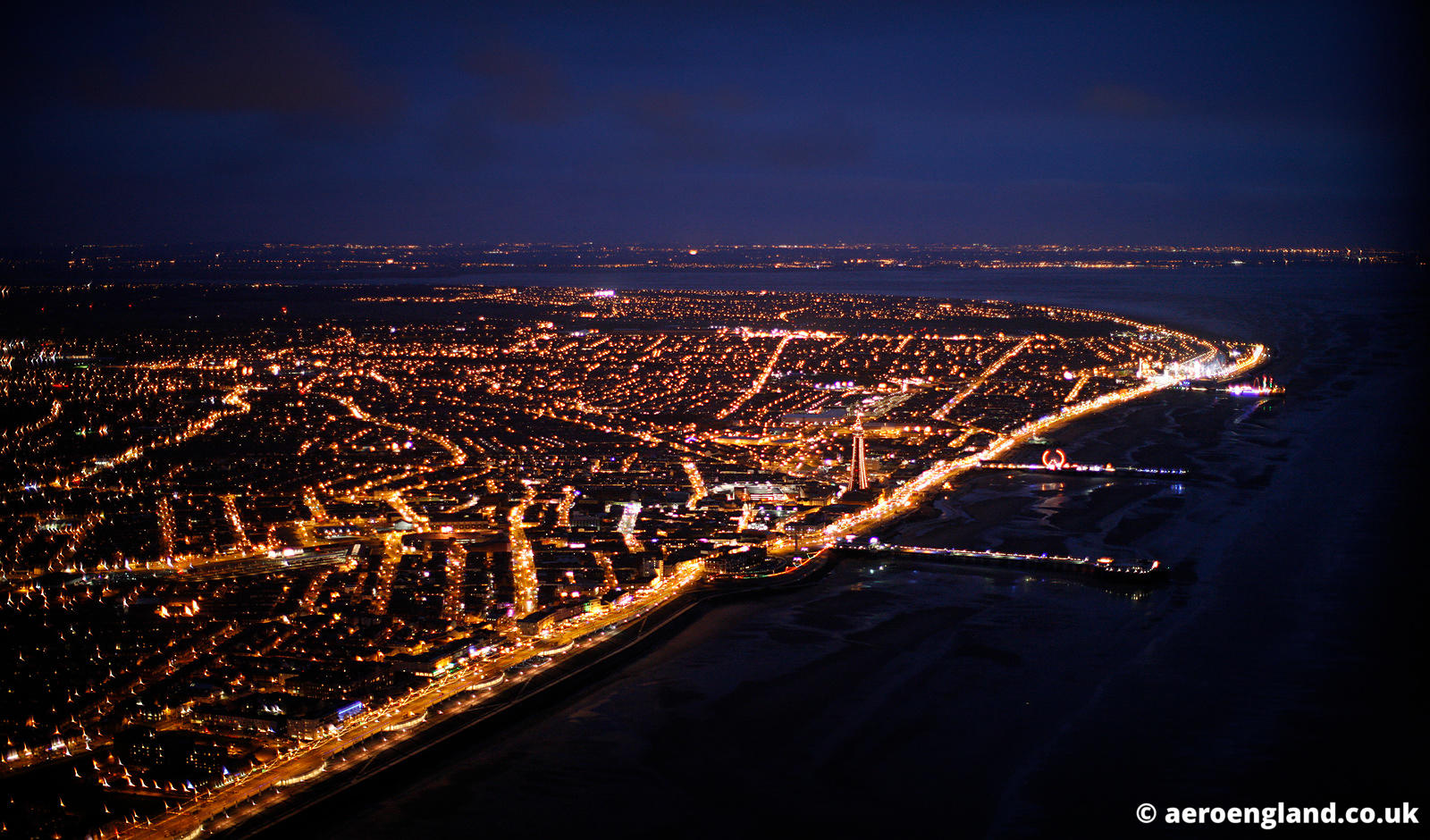
Supplement: Sly's Blackpool Tower analysis

Sly doesn't seem to have Google Earth Pro (where you can draw 3D lines & polygons) so I thought I would add a few bits of information about Blackpool Tower and the surrounding geography beyond his Live Stream.

Our subject is Blackpool Tower and I've drawn a 3D polygon where the Heart is:


The aerial image Sly shared was from aeroengland -- which is from the backside but shows nicely what should be well lit on the piers.


And one more view from webbaviation shows that the lighting gap on the Ferris Wheel isn't always in the same position:


Here are the 3D sightlines drawn from Hoylake -- you can see the heart sightline is just a bit above the Ferris Wheel, which is why you can't see the Ferris Wheel -- which means about 165 feet is hidden from view.


Shnaz Shin also points out that the images in question were taken at low Spring tides so we're seeing further than we would at a high tide.

If we use 14% refraction in our calculator we estimate an observer height of about 21 meters above the water level at the tangent to give ~165 feet hidden.

And... Google Earth Pro crashed and lost all my markers so I guess I'm done for now.  Asking for more details and might do more updates based on that.

Ok, got more data...

N53° 23' 56.69"
W3° 10' 36.32"
date 29 Apr 2017
time 2115

So taking the image from Ranty's video I did as Shnaz Shin did and overlayed it along the lines of sight from Hoylake.  I 100% agree with Shnaz Shin -- this is NOT the mirror ball and you CANNOT turn the world sideways and try to overlay the image as Ranty wanted to do, that's just ridiculous.

I did the overlay at several points and you can see how the scale remains aligned with the lines of sight.


Even if the Earth was flat it wouldn't be the mirror ball, it's WAY LOWER than the top of the HUGE rollercoaster right behind it!

Friday, June 2, 2017

LO-1 Earthrise, 23 Aug 1966 - Celestia recreation

I found some neat information about one of the more famous Earthrise images the other day, the First Earth-Moon image taken by the Lunar Orbiter 1 (which was recovered from old tapes by the LOIRP).

In that data was an analysis of when and where the image was taken of frame 1102:


Since this gives a lot of detail about the image I decided to try to recreate it in Celestia

My first attempt failed, the images didn't match (it was close but not close enough) so I had to do some more research.  What I found was this data sheet contains a slight omission of a negative sign for the Lunar Latitude latitude of the spacecraft!

This page details the Spacecraft Position as:
  Altitude: 1198.22 km
  Latitude: -9.76°
  Longitude: 150.37°

So using those values we immediately get good agreement with the data -- from an open source program that is built on the heliocentric model...


I think that's pretty neat -- not only did we find a good match with the image but we found an error in the data because the data given did NOT match.


Sorry, I don't have high-resolution images loaded for my Celestia moon.

Quick Debunk Beau Rivage Casino Hotel from 13.1 miles away proves Earth is Flat

The Video:


What we see...

The Beau Rivage Casino Hotel is 346 feet (or maybe 347 feet).

Since the top section of the building is ~53 feet high (estimated from inset image by taking the fraction of that height from the total building - confirmation of this is that the windows align very well in the overlay so our error is reasonably small).

By taking the total height (346 feet) and dividing it by our ruler length (53 feet ~ 102 pixels) we find approximately how many top sections should equal the total height of the building...

(346/53) = 6.5283

Now we just multiply that by the 102 pixels we measured and we get the estimated total height of the building in pixels.

(346/53)*102 ~ 665.8 ~ 665.8 pixels

So our whole building should be about 665.8 pixels high and THAT should align with the inset image.

The curvature drop height from here would be about 114.4 feet but since our observer is about 5 feet above the water that means that only (ignoring refraction) about 71.6 feet should be hidden.

And we can take the 71.6 feet that should be obscured by the horizon and convert that into pixels:

(71.6/53)*102 ~ 138 pixels

So about 138 pixels of the hotel should be hidden.


What we find is an extremely good match between the P900 image, the closer inset image that shows the true height of the hotel, and our calculated estimates based on those images and the information about the actual height of the hotel.

Inset image is from John Whelan:


So I would say this confirms the Globe Earth model very well.